


Blog
- By Admin
- 7 September, 2025
- Technology
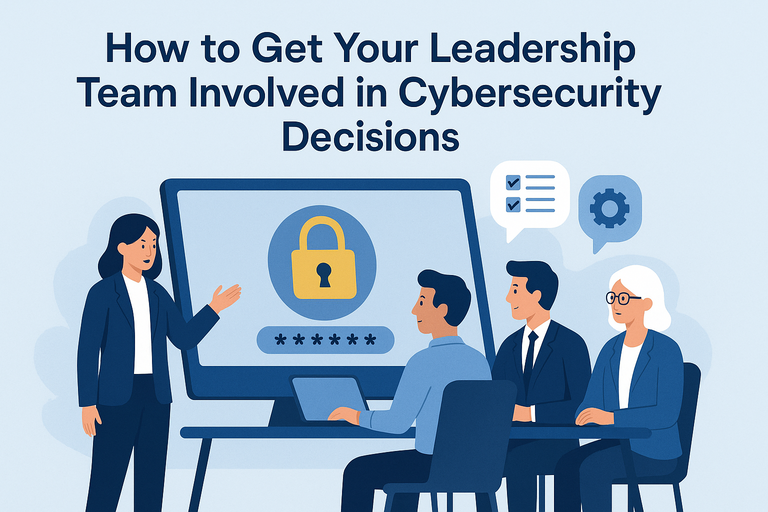
How to Get Your Leadership Team Involved in Cybersecurity Decisions
In many organizations, cybersecurity is still seen as “an IT issue.” But in reality, it’s a business issue — one that affects financial performance, client confidence, and even a company’s long-term viability.
Every executive decision — from new technology adoption to vendor partnerships — carries cyber implications. When leadership teams treat cybersecurity as a strategic business priority, they not only strengthen resilience but also create a culture of accountability across the entire organization.
For South Florida businesses — particularly law firms, healthcare providers, and professional service companies — executive involvement in cybersecurity isn’t optional anymore. It’s a critical factor in achieving operational excellence, client trust, and regulatory compliance.
1. Recognize Cybersecurity as a Business Risk, Not Just an IT Task
The first step to meaningful executive engagement is reframing cybersecurity as a core business risk. Cyber threats today can interrupt operations, compromise client data, trigger legal penalties, and damage reputation in ways that take years to rebuild.
As we highlighted in Cybersecurity Starts with Your Team, most breaches result from human error rather than technology failure. That’s why leadership must see cybersecurity as a shared responsibility — one that blends governance, training, and culture, not just firewalls and software.
Executives who understand this shift are more likely to invest proactively, rather than reactively, in risk management and awareness initiatives.
2. Appoint a Cybersecurity Champion at the Executive Level
Strong leadership starts with ownership. Designate a cybersecurity champion within your executive team — ideally a CIO, CTO, or managing partner who can bridge the gap between technical teams and business strategy.
This individual doesn’t need to be a cybersecurity expert but should be responsible for:
- Communicating risk updates to the board or leadership team.
- Overseeing audits and compliance reporting.
- Ensuring cybersecurity remains a recurring topic in business planning sessions.
By establishing clear ownership at the top, cybersecurity becomes embedded in decision-making, not an afterthought delegated to IT.
3. Integrate Cyber Risk Into Business Planning
Cybersecurity and business strategy are two sides of the same coin. When you integrate cyber risk management into budgeting, strategic initiatives, and performance metrics, you create a structure where security drives business growth.
As discussed in How Effectively Managing Risk Bolsters Cyber Defenses, treating cybersecurity as part of enterprise risk management allows leaders to balance innovation with protection.
Practical ways to embed this include:
- Requiring a cyber risk review before any major investment or system rollout.
- Allocating specific budget lines for cybersecurity tools and training.
- Including cyber resilience metrics in annual business performance evaluations.
This approach helps leadership view cybersecurity not as a cost center but as a strategic safeguard — much like insurance or compliance — essential for long-term stability.
4. Encourage Cross-Department Collaboration
Cybersecurity isn’t confined to IT. Every department — HR, legal, finance, operations, and marketing — touches data and plays a role in safeguarding it.
Encourage cross-department collaboration by hosting joint planning sessions, creating shared communication protocols, and conducting organization-wide incident simulations. These exercises reveal how different teams interact during a crisis and where improvements are needed.
For practical guidance on building these habits, see Bolster Cyber Defenses with Routine Security Tests, which outlines how regular, scenario-based testing helps leadership teams identify vulnerabilities before they become real threats.
The goal: transform cybersecurity from a siloed technical function into a company-wide discipline supported by every department.
5. Use Metrics and Reporting to Maintain Accountability
Executives value metrics — and cybersecurity is no exception. Develop clear, business-friendly dashboards that track meaningful indicators such as:
- Time to detect and respond to incidents.
- Employee training completion rates.
- Phishing simulation results.
- Audit and compliance outcomes.
By visualizing progress, leadership gains a real-time understanding of where the organization stands. This visibility also strengthens accountability, encourages continuous improvement, and makes it easier to justify ongoing investments in cybersecurity programs.
Over time, metrics-driven reporting transforms cybersecurity into a data-informed leadership conversation rather than a reactive discussion after a breach.
6. Lead by Example
Perhaps the most powerful influence comes from leadership behavior. When executives follow secure practices — enabling multi-factor authentication, using strong passwords, and taking cybersecurity awareness training — they send a clear message that security is a top priority.
Leadership actions have ripple effects. When employees see executives taking cybersecurity seriously, they are far more likely to do the same.
This visible commitment turns cybersecurity from a compliance requirement into a core company value — one that’s reinforced daily by example rather than policy alone.
✅ The Takeaway
Cybersecurity is not just about technology — it’s about leadership. Executives who embrace cybersecurity as part of business strategy create stronger, more resilient organizations capable of withstanding the next wave of digital threats.
By recognizing cyber risk as a business issue, appointing dedicated leadership champions, tracking measurable progress, and modeling best practices, South Florida businesses can cultivate a culture where security starts at the top.
At Ulltium Consulting, we help leadership teams align cybersecurity strategy with business goals — ensuring your organization stays both compliant and competitive in today’s fast-changing landscape.
Slug:
👉
Would you like me to add the SEO title and meta description next (like we did for the previous articles), so this one is also ready for upload to Ulltium’s CMS?
Search
Resent Post
-
 16 February, 2026
Downtime Is Predictable. Recovery Should Be Too.
-
 16 February, 2026
The Hidden Risks of DIY AI Implementation
-
 16 February, 2026
Why an IT Risk Assessment Is No Longer Optional
-
 28 September, 2025
How to Use Blockchain to Secure Legal and Financial Records
-
 25 September, 2025
How to Make Your IT Infrastructure Both Sustainable and Secure