


Blog
- By Admin
- 28 September, 2025
- Technology
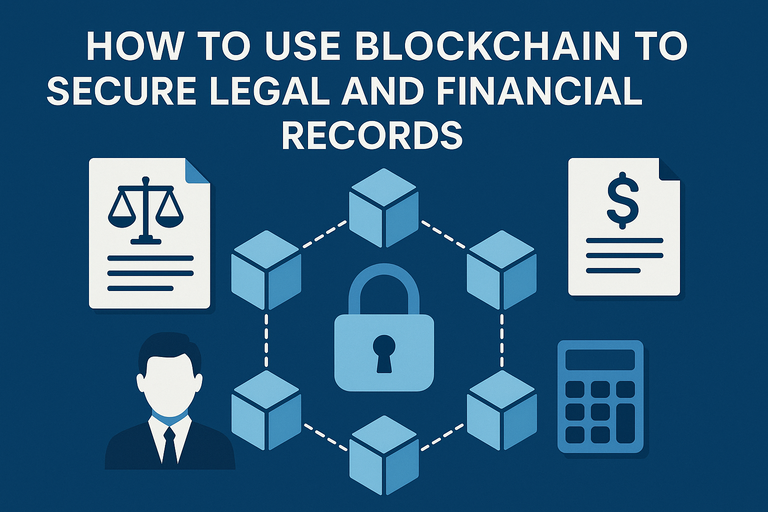
How to Use Blockchain to Secure Legal and Financial Records
In an era when data breaches, fraud, and compliance pressures are escalating, trust and transparency have become non-negotiable. Law firms, accounting practices, and financial institutions in South Florida manage massive volumes of confidential data every day — from client contracts and case files to high-value financial transactions.
That’s where blockchain technology comes in. Once associated primarily with cryptocurrency, blockchain is now emerging as a powerful tool for data integrity and cybersecurity, particularly for legal and financial professionals who depend on verified, tamper-resistant records.
1. Understand What Makes Blockchain Secure
At its core, blockchain is a distributed digital ledger that records transactions across multiple computers. Each “block” of data is securely linked to the previous one, forming a chronological chain that’s virtually impossible to alter without detection.
This decentralized structure creates a tamper-evident system ideal for storing sensitive legal and financial records. Once a contract, case file, or transaction is recorded, it cannot be modified retroactively — ensuring an immutable audit trail and enhancing client trust.
Our article on Quantum Computing and Cybersecurity explains how emerging technologies may challenge traditional encryption systems. Blockchain’s cryptographic design adds an additional layer of resilience by distributing trust across multiple nodes — removing single points of failure that attackers often exploit.
2. Identify Use Cases for Legal and Financial Applications
Blockchain’s true value lies in its ability to verify, not just protect, information. For South Florida firms, that verification power translates into tangible business benefits:
- Smart contracts: Automate legally binding agreements between parties, reducing manual processing, delays, and manipulation risk.
- Immutable records: Store client data, case histories, or transaction logs in a verifiable, unchangeable format.
- Chain of custody: Track sensitive evidence or financial document flows to ensure authenticity during audits or disputes.
These applications are especially valuable for organizations governed by strict regulations like the ABA Cybersecurity Rule, GDPR, or CCPA, where auditability and integrity are key.
If your firm manages compliance across multiple frameworks, How to Achieve Strategic Cyber Risk Management with NIST CSF offers a roadmap for aligning blockchain-based controls with broader cybersecurity standards.
3. Combine Blockchain With Existing Cybersecurity Frameworks
Blockchain is not a standalone solution — it’s a reinforcement layer that strengthens existing security controls.
Integrate blockchain with encryption, multi-factor authentication (MFA), and identity management systems to enhance traceability and accountability.
For example:
- Law firms can timestamp digital evidence using blockchain to prove authenticity.
- Financial advisors can record and verify client transactions on distributed ledgers to prevent tampering or internal fraud.
To reduce insider risk, review Insider Threats: How Miami Law Firms Can Mitigate Internal Risks, which explores how layered defense strategies — including blockchain verification — safeguard sensitive records.
4. Choose the Right Blockchain Model
Not all blockchains are public or anonymous. For regulated industries like law and finance, private or permissioned blockchains are typically the most appropriate.
These systems provide the same cryptographic integrity as public blockchains but give organizations control over who can view, add, or validate records.
Consider enterprise-grade frameworks such as:
- Hyperledger Fabric: Ideal for internal data sharing across legal or accounting teams.
- Quorum: Tailored for financial applications requiring transaction privacy and scalability.
Collaborate with IT experts who understand both blockchain technology and your regulatory obligations to ensure security and compliance remain tightly aligned.
5. Address Regulatory and Ethical Considerations
Regulatory compliance is paramount. Because blockchain data is immutable, businesses must plan for how to meet “right to be forgotten” requirements under privacy laws like GDPR and CCPA.
Techniques such as encryption, data minimization, and tokenization can help anonymize sensitive data while retaining verifiable records.
Beyond compliance, blockchain enhances auditability — enabling firms to demonstrate security controls and provide regulators or clients with transparent, real-time proof of integrity without disclosing confidential information.
The Takeaway
Blockchain technology gives South Florida law firms, financial institutions, and professional services firms a new way to secure sensitive data while strengthening client trust.
By offering tamper-resistant, transparent, and verifiable records, blockchain helps organizations enhance compliance, streamline workflows, and reduce the risk of fraud or manipulation.
When combined with traditional cybersecurity frameworks and ethical governance, blockchain becomes more than a trend — it’s a strategic advantage for organizations committed to both innovation and integrity in the digital age.
Search
Resent Post
-
 16 February, 2026
Downtime Is Predictable. Recovery Should Be Too.
-
 16 February, 2026
The Hidden Risks of DIY AI Implementation
-
 16 February, 2026
Why an IT Risk Assessment Is No Longer Optional
-
28 September, 2025
How to Use Blockchain to Secure Legal and Financial Records
-
 25 September, 2025
How to Make Your IT Infrastructure Both Sustainable and Secure